|
By Rev. Heather J. Blais, Rector 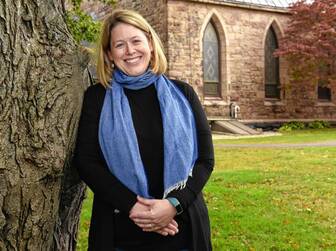 Today, let us turn our attention towards the second reading:
Paul’s first letter to the Thessalonians. Thessalonica was located in what is now modern day Greece, in a port city along the Aegean Sea. In antiquity, port cities were often information and resource hubs, where new ideas and goods were exchanged and spread. The Thessalonians proximity to the sea put them in the direct path of Paul and his missionary partners as they went about sharing the Good News of Christ beyond Syria-Palestine. Scholars believe this letter was composed around 41 CE, written several months after Paul left this newly formed community.* This means the letter was written roughly eight years after Jesus of Nazareth’s life, death, and resurrection. There were no gospels written yet, or any other significant early writings. Let alone church canons, catechisms, policies and procedures. The early Church is relying on word of mouth, and trusting wholeheartedly in the Holy Spirit. This letter is considered the earliest of Paul’s writings, making it quite probably the earliest composed document within the Christian Scriptures.** While we refer to the letter as Paul’s, scholars remind us that it would have actually been written by Paul and his missionary partners, Silvanus and Timothy.*** The content of this letter is not Paul’s personal opinion, but rather the opinion of a few early Church leaders.*** Paul’s missionary partner, Timothy, had recently visited the community, and reported back on how well they were doing. He also conveyed some of their concerns. In the segment of the letter we heard today, Paul responds to a matter that had been deeply distressing to the community, leaving them bereft of hope. The Thessalonians wanted to know: What will happen to believers who have died when Christ comes again? This question may seem odd to us, as we’ve had two thousand years to acclimate to the idea that Christ will come again…someday…probably long after we’ve been gone.* Like the Thessalonians, we too have our own worries that cause us distress, but this particular concern is lower on our list. But here is why it mattered so much to the Thessalonians. Members of this early church community in Thessalonica had previously been pagan, having been formed by the beliefs of ancient Greece.* Commentator Kristofer Phan Coffman explains: “For many ancient Greeks, the dead were thought of as doomed to separation from the living in the underworld. They were shades of their former selves without thoughts or feelings. This separation from the living was not a punishment, but it was permanent….[The Thessalonians] look forward to Jesus’ triumphant return, but many of them are grieving because they believe that death has permanently separated them from their loved ones. These are the people whom the senders of the letter describe as having no hope.”* Last week we celebrated the Feast of All Saints, where we shared photos of our deceased loved ones. We did so with trust and confidence that we will be together again. Yet the Thessalonians were operating under the cultural beliefs of ancient Greece. While they were eager to be with Christ in the second coming, they felt hopeless about being permanently separated from their loved ones. And so, Paul, Silvanus, and Timothy did their best to respond to this distressing concern. Commentator Coffman goes on to write: “The trio then begin their work of introducing a new way of thinking about death to the Thessalonians. Their new way begins with their bedrock belief: Jesus died and rose again (4:14). Right away, this strikes at the heart of the Thessalonians’ understanding of death. Unlike Greek heroes, Jesus was not held down by the power of death. Unlike the Greek underworld, death has no permanence for those who die in Christ. Death and the world, though they seem eternal, will one day pass away.”* This letter is a word of hope.* A word of hope for the Thessalonians, and for each and every person to come after. We have loved and lost children, siblings, parents, grandparents, friends, and neighbors. We know the pain of grief, the ache of mourning. This letter boldly reminds us: There is always hope in Christ. It is death that is temporary. Christ will forever be stronger than death. It is life which is eternal. In eternal life we are reunited with those we have loved and lost, and God, the Source of Love. As our reading concludes, “…we will be with the Lord forever. Therefore encourage one another with these words” (4:18). In the meantime, in the vast expanse between the incarnation and Christ’s coming again, we are invited to lean into our shared Christian hope. Unlike the Thessalonians, we do have a catechism which outlines the core tenants of our faith. Our catechism is located in the back of our prayerbook, and on page 861, is a section that outlines our shared Christian hope. It is the Episcopal Church’s effort to answer the same questions that had initally left the Thessalonian community so bereft of hope. The catechism poses a question, followed by an answer: Q. What is the Christian hope? A. The Christian hope is to live with confidence in newness and fullness of life, and to await the coming of Christ in glory, and the completion of God's purpose for the world. This question is followed by another question: Q. What do we mean by the coming of Christ in glory? A. By the coming of Christ in glory, we mean that Christ will come, not in weakness but in power, and will make all things new. While there are several more questions, it is the last one that we need to hold onto. Q. What, then, is our assurance as Christians? A. Our assurance as Christians is that nothing, not even death, shall separate us from the love of God which is in Christ Jesus our Lord. Amen. I would argue that the Episcopal Church’s theology has expanded since the prayer book was published in 1979. There is an even more expansive sense that God’s love is not solely for Christians, or those who might be perceived as ‘the chosen’, or those who opt in. God’s love is radical, unconditional, and eternal. God’s love is for the entirety of the human family. God’s love is poured out into creation and furthered through the incarnation, as we see Jesus model a life of love, and then commission followers of the Way of Love to further God’s dream for this world. As Michael Curry said in his 2021 Easter sermon, “Our work goes on. Our labor for love continues...We will not cease, and we will not give up until this world reflects less our nightmare and more God’s dream where there’s plenty good room for all God’s children. Hallelujah anyhow.” A brief aside about today’s reading, and the verses that follow into next Sunday’s second reading. This text, which is meant to affirm our Christian hope that we will be reunited with those whom we love in the Eternal Source of Love, has also been used in more recent history to perpetuate what I would describe as harmful theology. Drawn from today’s text are some of the primary verses used to formulate ‘rapture theology’, which is a broad term that covers different but similar teachings that believe Christ will seize or abduct the true believers, leaving everyone else behind. While rapture theology was initially meant to bring comfort, I think it sounds a bit more like a psychological thriller. I’ve seen the harm it can cause up close. My grandmother was a devout Christian, who worshiped with various Christian communities that did not belong to any particular larger denomination. She made it her personal mission to always ensure people knew they were loved by God, including with her answering machine which proclaimed ‘and remember, you’re special’. She truly meant it. Yet after her sudden death, as we emptied out her apartment, we found evidence of an enduring doubt that she would not be considered a ‘true believer’, a worry that she had not been good enough, that she would be left behind. It breaks my heart to think she, or anyone else, would leave this life with even a trace of doubt that they are wholeheartedly beloved by God. Because if there is one thing we can know for certain it is that yesterday, today, tomorrow, and always, God is the Eternal Source of Love. When we come across teachings that challenge the reality of God’s Love, we need to ask ourselves:
As we prepare to head back out into the world today, I would encourage us to heed the advice at the end of today’s passage, ‘encourage one another.’
Or maybe we feel as though we have lost hope. Might we be brave like the Thessalonians? What teacher or friend might we turn to and share our concerns? Always remember that we are loved beyond measure, and nothing can separate us from the Eternal Source of Love. Amen. * The first part of this sermon was heavily influenced by the commentary offered by Kristoff Phan Coffman: https://www.workingpreacher.org/commentaries/revised-common-lectionary/ordinary-32/commentary-on-matthew-251-13-9 ** The Jewish New Annotated New Testament, Second Edition, pg 419. *** https://www.workingpreacher.org/commentaries/revised-common-lectionary/ordinary-31/commentary-on-1-thessalonians-29-13-6 Comments are closed.
|