 The lectionary does an odd thing in these Easter weeks in the B cycle. You’ll recall that the lectionary, or schedule of lessons we’re assigned to read each Sunday, has three rotations. In the “A” year we mostly hear the gospel as Matthew tells it, with his emphasis on Jesus’ parables; in the “B” cycle – which we’re in this year – we mostly hear Mark’s version, a more fast-moving, action-oriented gospel; and then in the “C” year, we hear how Luke understands the gospel story, with his interest in Jesus’ outreach to society’s outsiders.
There’s no cycle for John. It’s quite a different account from the other three. John covers both less and more: it includes fewer stories of Jesus’ ministry – the healings, general teaching, and everyday encounters with people who came to see and hear him – but goes to much greater detail in those stories he does include in his narrative. It is only John who gives us some of the key accounts that give us insight into Jesus’ mission and ministry, including the wedding at Cana, the raising of Lazarus, the Samaritan woman to whom Jesus reveals his identity at the well, and the “doubting Thomas” incident we hear on the second Sunday of Easter every year. When the framers of the lectionary set it up, they spliced these unique passages from John into the Matthew, Mark, and Luke cycles so that we could benefit from hearing them even though – for whatever reason – John didn’t get a cycle year of its own. Which brings me back to my observation of the peculiarity of the lectionary’s structure in this “B” year’s Easter season. Instead of continuing with accounts of what was happening for the disciples in the time between the resurrection, the ascension and Pentecost, as would seem logical, the “B cycle” takes us back to hear Jesus’ words to the disciples at the Last Supper. Last Sunday, today, and next Sunday we hear excerpts from what is known as the “Farewell Discourses”, material that is unique to John’s gospel. As Heather suggested in her sermon last week, it is important to hear these passages in context, specifically, that they represent what John wants us to understand to be the final words that Jesus shared with his friends in the last hours before his arrest. Heather summarized it this way: “In the verses that precede our lesson, Jesus modeled for his disciples what it means to love one another by washing their feet. Now he is advising the disciples to abide, and in the verses that come immediately after our lesson, to love.” The repeated theme throughout the “Farewell Discourses”, as Heather pointed out, is relationship. Jesus emphasizes the relationships between himself and the disciples, a relationship that mirrors the relationship between himself and the Creator, his source and grounding, whom he referred to as “Father”. Jesus offered the metaphor that “I am the vine, and you are the branches”, conveying not only that the bonds between himself and his friends could not be broken, but that whole and complete life is not possible if one is cut off from the source that gives us life and enables us to “bear fruit”. These words of reassurance were undoubtedly intended to provide comfort for the disciples, an image to remember and hold onto in the days following his death and his eventual departure, when the loss of his physical presence could well feel like loss of the relationship. His words undoubtedly provided the same comfort and reassurance to the early Church community for whom John’s gospel was written, about 60 or 70 years later, as they suffered under persecutions by the Roman Empire. In the part of the passage that we have heard this morning, Jesus goes beyond emphasizing the relationship between the Father, himself, and the disciples: he reminds his friends of the love that is at the center of the relationship, and urges them to sustain it: “As the Father has loved me, so I have loved you” and “This is my commandment, that you love one another as I have loved you.” As Heather pointed out last week, throughout these farewell passages Jesus repeatedly entreats his friends to “abide” in him, and in his love, just as he abides in them, and, of course, in us. He uses the word “abide” eleven times in the eleven verses of this extended text. Even though we don’t use the word much ourselves, these days, we know what “abide” means. We know it means to dwell, to stay, to shelter, to inhabit a particular context or environment. “Abide” suggests calm, a restful place to dwell – we’d never say someone “abides” in prison, for example, or in a war zone. Cynthia Briggs Kittredge points out that dwelling or abiding is a theme throughout the whole Gospel of John. Discussing the opening verses of John, which declare that “the Word became flesh and lived among us”, she observes that the Greek more literally could be translated that the Word dwelt among us as in a tent.* “The Word pitched a tent or “camped out” among us”, she observes, “and showed us the embodiment of God’s love. In Jesus’ life, God’s love walked and talked among the people of first-century Galilee and Judea.”* And it is in God’s love that Jesus calls us to find our shelter, and then, to express that love to one another. “Abide in my love,” he says. “Make my love the house, the tent, the shelter in which you dwell and move around in,” he seems to say.* We all know how critical the place where we abide is. Thinking about our homes, when we have the resources to create a space that not only feels comfortable, but reflects our passions, our priorities, and our histories, we have a home base in which we can live with joy, and from which we can venture out boldly, and to which we can return for refreshment and renewal. On the other side of the coin, we’ve probably all had periods – hopefully brief ones – of living in spaces that were not our own and somehow felt alien or hostile, and we know how difficult it is to feel joy in our living there, or to thrive in our day to day life. We’ve also all lived through a pandemic in which our homes were both shelter and, which, at times felt somewhat suffocating. Jesus invites us to allow God’s love to provide us a safe, nurturing and empowering shelter. We can perhaps imagine Jesus elaborating, “Let my love be the foundation under your feet, let my love permeate the walls that shelter you, and let my love form the roof arching over your head.” And we know what it means to live grounded in Jesus’ love: We can live out of the dwelling of God’s love when we volunteer for Sunday Sandwiches or Second Helpings. We abide in God’s love when we call on a neighbor to check on how she is feeling. We do so when we work to reduce our carbon footprints. When we donate to humanitarian relief organizations that provide aid to those impacted by war. When we write emails to our local and national officials to express our concerns and solicit their action on the justice issues facing our communities and nation. When we abide in God’s love and strive to live as Jesus did, we are not satisfied to remain where we are. We recognize our own need to learn and to understand more deeply. We choose to engage with tough questions and try to bridge divides by listening to perspectives different from our own. The more that we can allow God’s love to be our dwelling place, our foundation and shelter, the more room we have to invite others to shelter there with us. In this season of resurrection, may we abide with Jesus in God’s love. May we find new ways and commit ourselves ever more fully to abiding in the love of the One who first loved us and who shows us how to love one another.
 By Rev. Heather J. Blais, Rector
Today’s gospel lesson from John takes place on the evening of Jesus’ arrest. In the verses that precede our lesson, Jesus modeled for his disciples what it means to love one another by washing their feet. Now he is advising the disciples to abide, and in the verses that come immediately after our lesson, to love. Jesus is hours away from his death. We can imagine the sense of urgency he must have been feeling as he tried to impart these final words to his disciples. We often witness a similar sense of urgency when we sit with loved ones as they make their final journey from life to death.
The point is that the emotional and spiritual process of offering and receiving final words is as essential to a good death as the body’s physical act of shutting down. As Jesus prepared for his own death, he needed his disciples, and all who would come after, to understand that a life of faith is inherently relational. In some ways, this shouldn’t be such urgent news. God has always been relational:
So on the eve of his death, why was it so important for Jesus to convey the intrinsically relational nature of faith? Well, I think Jesus anticipated his followers would need these words. He sensed his disciples would scatter. And in scattering, the disciples would abandon the teacher they loved so dearly, and the core values his Way of Love embodied. Jesus knew that on this side of the resurrection, his followers would be grappling with feelings of shame, regret, embarrassment, and remorse. Shame and embarrassment often leave us questioning our worthiness; doubting the love and forgiveness that is waiting for us if we are willing to accept such grace. This is exacerbated by the fact that self doubt and self-loathing often lead us to cast ourselves apart; removing ourselves from friends and community. Jesus knew there was a possibility these feelings might prevent his disciples from returning to the Way of Love and his community of followers that would eventually become the early Church. All this is to say, Jesus knew his followers, then and now, would need these words: “Abide in me as I abide in you. Just as the branch cannot bear fruit by itself in the vine, neither can you unless you abide in me. I am the vine, you are the branches. Those who abide in me and I in them bear much fruit.” (Jn 15:4-5a) Jesus used another beautiful agricultural parable to make his point. God is the vine grower, Jesus is the vine, and we are the branches. Together, we bear much fruit. As the branches, we depend on the vine, and collectively we count on the vine-grower to prune and care for the entire plant, in order that we may offer an abundant harvest. And it all comes down to this one word that Jesus used eight times in today’s reading: abide. Jesus is telling us: Remain in me. Live in me. Dwell in me. Stay united with me. Stay joined to me. Jesus knew that on this side of the resurrection, his disciples would need to be reminded that a life of faith is inherently relational, and that the community that made up the Jesus Movement needs them and is waiting for them. Because we need one another:
Here we are, centuries later, a people of faith striving to be loyal to God’s dream, of walking Jesus’ Way of Love, of bearing fruit that lasts. Just as the disciples were bogged down by their own shame and shortcomings, we too, can let our insecurities and wounds prevent us from fully engaging in this life. We hold back from building relationships. We let fractured relationships remain broken, journeying onwards, often in pain. At times we let that pain keep us isolated from others. Sometimes we seek to forget the pain, using alcohol, drugs, porn, shopping, gambling, food, social media and screens to distract us. Other times we will remain in constant motion, doing anything to avoid the pain. Yet, eventually, when our life begins to draw to an end, these are the wounds we find ourselves still reckoning with. These are the things we find ourselves wishing we had taken the time to resolve. Jesus' final words to his disciples didn’t necessarily come from pain. Still so often, our final words or the words we long to hear at the hour of our death, do stem from old pain. When I think of approaching our death without doing the work of sorting through our own wounds, I am reminded of a man I walked with as his life drew to a close. The medical professionals knew he would die any day, any moment. His children traveled from all over the world to be with him and say goodbye. I was called in to pray last rites, or rather the prayers we pray at the time of death. In the end, I was called in three different times to offer these prayers over the course of six months. This man, who was full of pain and brokenness, from choices he made during his life, could not face his wounds. Could not bear the thought of what might await him. It didn’t matter what words of forgiveness, grace, or love the hospice chaplain or I offered him, the good news of our God’s unconditional love. He didn’t think he was worthy of it, and therefore, feared what death might mean. His body eventually gave out, and I’ll never know if he eventually did make peace. But watching his emotional and spiritual agony was one of the saddest things I have ever witnessed. We can wish that kind of pain on no one. What if instead we did a wild, inconceivable thing, and lived our lives like tomorrow was our last day.
If a life of faith is inherently relational, Jesus calls us to do just that - fully engage in our relationships, as best we are able. It’s only when we free ourselves of these burdens, of the pains that hold us back from being fully alive, that we can heal and embrace the lifegiving work God has called us into. And this is not a one time thing. We get to do this dance again, and again, and again. As we prepare to head out into the world today, I would invite each of us to do some reflecting:
 By Rev. Heather J. Blais, Rector
Luke’s story of the empty tomb begins similarly enough to Mark's version that we heard on Easter Sunday, but he takes the story one step further. The female disciples had approached the burial tomb, found the stone rolled away and the tomb empty. This time there were two divine messengers, and they told the women that he was not there, he had risen. Yet the divine messengers make a point in telling them: “Remember how he told you, while he was still in Galilee, that the Son of Man must be handed over to sinners, and be crucified, and on the third day rise again” (Lk 24:6-7). The text goes on to say, “Then they remembered his words, and returning from the tomb, they told this to the eleven and to all the rest” (Lk 24:8-9). The messengers were making a point to remind the disciples that Jesus had told them - this was going to happen; there would be a resurrection. Yet this time around, the women do not flee in fear; they go and tell the disciples. The disciples seem to think the women are telling a tall tale, except for Peter, who runs to the tomb to see if there might be any truth to the story. He returned, “...amazed at what had happened” (Lk 24:12b). That same day, two of Jesus’ disciples were going to the village of Emmaus. They were feeling pretty downcast and defeated, because the man they thought had been the messiah, had been crucified and buried. While on the road, they encounter a stranger and share their troubling news. The stranger began to teach them the meaning of the scriptures, and when they drew near the village, they stopped and shared a meal together. And it was only then, when the stranger “...was at table with them, he took bread, blessed and broke it, and gave it to them. Then their eyes were opened, and they recognized him; and he vanished from their sight” (Lk 24:30-31). They immediately returned to Jerusalem to tell the other disciples. When we reach today’s gospel lesson, these two disciples are in the midst of telling the other disciples they had just encountered the resurrected Christ. While they were talking, Jesus appeared before them, wishing them peace. Yet the disciples were scared half to death. He assured them they did not need to be afraid, and encouraged them to touch his hands and feet, in order that they might see this was really Jesus. Even still, it was too much for the disciples; it was too good to be true. Jesus then asked for something to eat, and they handed him a piece of broiled fish. It was only then that Jesus was recognizable to them, in this shared communal meal. Ghosts and angels do not eat, so indeed, Jesus lives. It was only after Jesus had calmed their fears, that he could then impart one final lesson before ascending into heaven. In both of Jesus’ resurrection appearances in Luke’s gospel, the disciples do not recognize him until they share a meal together. It is only then they know Jesus lives. As preacher Laura Holck wrote, “By eating fish with his friends, Jesus also demonstrates the pathway forward: we move into the realm of resurrection every time we eat together. And although resurrected life is always possible when we eat together, it only materializes when we get real with each other. It materializes when we share our wounds.”* In other words, it matters that we gather each week to worship God and share in our eucharistic meal together. It is how we are reminded that Jesus lives in our relationships, in our work, in our communities, and in how we care for ourselves.* In a world with a 24 hour news cycle full of discouraging and fearful stories, we need to remember the hope of the resurrection; of all that is possible when we gather together as the body of Christ and proclaim Jesus lives. Preacher Laura Holck goes on to write: “Too often people live in a privatized transactional religion, offering prayers and devotion hoping God will exchange them for resurrected life. But Christianity is much more than that. Christianity is living a communal life of shared pain, sorrow, and hope, where breaking bread together transforms everything and we experience resurrected life while we still live, where calling upon the name of Jesus in our midst brings healing and new life amid what formerly was only death, despair, and isolation.”* For Christians, the lifecycle of faith is not an individual, private journey. We can certainly try to go about it alone, but it will feel more like a half-life. Because in our faith tradition, we are meant to be in community, to recognize Jesus lives whenever and wherever we gather to be the Church. We experience the resurrection each and every week when we break bread together. We experience the resurrection as we witness our little ones joyfully and boldly singing along with the community, somberly carrying forward the bread and wine, running in circles in our sanctuary to remind us of our call to have a child-like faith, and as they recognize, better than many of us, that something very special is happening during communion. We experience the resurrection each and every time we gather together to witness and celebrate the baptism of a new member into the body of Christ. This means, Jesus lives not just on the day of resurrection, but Jesus lives right now, right here, as we baptize Max and Wendy. In the baptism liturgy, we promise as a community to walk with Max, Wendy, and one another through the highs and lows of this life. We, as the Church, are in this together, and we’ve got you. We may be an imperfect mess, but Gods’ Love is our North Star and we are in this with you, forever and always. The baptismal covenant, the promises we make in baptism and reaffirm again and again throughout our lives, are in a question and answer format. The first three questions ask us about our belief in God the Creator, God the Son, and God the Holy Spirit. Then the questions shift from what we believe to how we will live. The first question of how we will live asks: Will you continue in the apostles' teaching and fellowship, in the breaking of the bread, and in the prayers? This may be the most important question about how we will live, as our answer will inform how we will respond to the rest of the questions. Because the Church recognizes that in order to keep remembering that Jesus lives in us and the world around us, we need to keep gathering in fellowship and worship, we need to keep breaking bread and praying together.
It all relies upon our belief in the story of God’s love in creation and in Christ, our faith in one another, and our shared communal worship and life together. Whether we were baptized as a little one, as Max will be, or as an adult, as Wendy will be, baptism is a choice to put love of God’s creation, love of God’s children, and a belief in a better world before all else. It is making the choice to engage in a life of love, joy, hope, and healing. We all come from a variety of spiritual backgrounds, and maybe you’ve been baptized, and maybe you’ve not made that choice yet. As Jimmy noted last week, as Anglicans we gather around the book, font, and table, which informs how we live our lives out in the world. With that in mind, know that this baptismal font, along with our altar and scriptures, are here to symbolize God’s standing invitation to abundant life. If you would ever like to explore being baptized, let’s make it happen. And for those who have been baptized for decades, may this font always symbolize the life we choose in God, and God’s invitation to commit ourselves, again and again, to a life of love. Whenever we gather around this font, and around this table; as we listen to the scriptures; may we remember that Jesus lives. As we prepare to baptize Max and Wendy today, and to renew our own baptismal vows, I would invite each of us to do some reflecting:
* Laura Holck in Sundays and Seasons: Preaching, 2024, p.139. 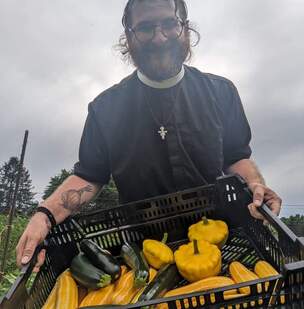 by Rev. Jimmy Pickett
Today’s Teaching Sermon will focus on the end. Don’t worry, not the end of all things, but the end of the liturgy, or more accurately, how the Dismissal is an integral part of our life of faith and witness in the world. The Dismissal is not like the school bell that calls us to recess nor does it dismiss us from class or excuse us from work, it is the hinge point between our worship and our witness. As Episcopalians, one of the member branches of the Anglican Communion, we are the inheritors of a particular way of living our faith out in the world. There is a branch of Practical Theology known as Anglican Social Ethics. At its core, this particular kind of witness is marked by a constantly evolving tension, at best a life giving tension, between Scripture, Tradition, and Reason. As Fr. Richard Meux Benson, founder of the Society of Saint John the Evangelist, said “the necessary thing for us is to set about old things in new ways”. I wish I could give you an easy checklist of to-do’s to make for a simple and easy Anglican Social Ethic, but our tradition is so situational that each of us needs to come up with our own list based on the situation we find ourselves in. Our list of personal and corporate prayers, practices, study, rest, and work to be done is based on particular life circumstances and the particular moral questions at hand. Scripture, Tradition, and Reason (lived experience), are the collective markers that can help point us toward the right decisions and actions. Again, there is this tension between the old and the new, the particular and the general, the personal and the communal. We lean on Scripture to learn how God and humanity interact and respond to each other. My Hebrew Scripture professor in seminary, Dr. Judy Fentress-Williams, once called Scripture a love story between the Human and the Divine. We lean on the Tradition we have inherited in our worship. The words may change from generation to generation, from community to community, but the common Ordo, or shape, of the Liturgy remains. The deep and ancient rhythm of worship - of gathering together, reading and responding to the Living Word in Scripture, praying for the needs of the world (and our own needs), confession, forgiveness, peace, the offering of our gifts, the taking, blessing, breaking, and giving of the Bread of Life, and being sent out - shapes us and points us to the dream God has for us. We lean on Reason and experience to make sense of our time and place as we share this life together with our neighbors. As Anglicans, we gather around Book, and Font, and Altar to be nourished by the Ancient and the Holy in order to go out to learn with, abide with, and break bread with whoever we meet. I’ll give you a couple of examples of what this can look like on the ground and then share my experience and then I’ll invite you to reflect on how you will go out into the world with the commissioning of the Dismissal. Dr. Esther Mombo, in her article “Doing Theology from the Perspective of the Circle of Concerned African Women Theologians”, describes her experience. Dr. Mombo is a Kenyan Anglican, Theologian, and Professor at St. Paul’s University in Limuru, Kenya and she is a member of a community known as The Circle of Concerned African Women Theologians. The Circle is an eccumenical and interreligious gathering of grassroots theologians from a diverse variety of socio-economic and cultural backrounds who are committed to living life together while critically engaging with society. They do this work by studying Scripture and culture, learning from each other in a pluralistic religious environment, focusing on formation for ministry and theological education, and listening to the stories of women in order to “do theology”. The Circle looks at structures of society and questions if they are in line with the love of God and neighbor. These questions have led to actions and social reform rooted in the continual revelation of God’s work of reconciliation. Another example: Dr. Timothy Sedgwick in his article, “The Anglican Exemplary Tradition”, explains the distinct nature of Anglican Social Ethics. The Exemplary Tradition is a way of living out a practical piety where Jesus is our great exemplar, calling us to model our lives around acts of worship and hospitality. For Dr. Sedgwick, social ethics is not just a thought experiment in a classroom or a sermon illustration, but a practical set of practices for living the Christian Life that holds a Sacramental vision for the relationship between church and society. “The final end of the love of God and neighbor is given in specific intentions embodied in particular actions such as eating and drinking, care for those in need, and prayer and worship”. Now for my own experience. A year ago, when I was in my last semester at Virginia Theological Seminary, one of my professors brought a classmate and I to Nashotah House, another Episcopal Seminary out in Wisconsin for a weekend of prayer, fellowship, and conversations. VTS and Nashotah are pretty much on the opposite ends of the theological and political spectrum from each other. While there were many differences in thought, there was fruitful conversation born out of common respect, common worship, and the sharing of meals and stories. This kind of cross political and cross theological conversation helped me to dig deeper into my own call and vocation- literally dig- of being both farmer and priest. When I was about 12 years old, I began to serve as an acolyte and week after week I would stand next to the Altar. I was transfixed on the Bread that was being lifted, and broken, and shared in blessing. My theological imagination was sparked and I could never see food the same way again. Being nourished by the Body of Christ to be the Body of Christ sent me to go study Sustainable Agriculture in college where I said yes to God’s call on my life while I stood in a field of onions with community members growing food for local food pantries. And here we are now. You've heard the basic structure of Anglican Social Ethics and listened to three stories of how we can live into the tradition we have inherited. Now what is God calling you to do with your Baptism? How is God calling you out the door to be the Body of Christ? How will you respond to the commissioning of the Dismissal? How will you come back next week, changed? Amen. |