
|
Most of the time I live day-to-day, thinking about what must be done or where I have to be. Setting aside time to think about the bigger picture is difficult and, in periods of uncertainty, really anxiety producing. My favored response has been to make trips to the library to check out several English style mysteries that I read back-to-back. However, in the face of our climate crisis, I am moved to action. As part of making changes I am reading Andrea Cohen-Kiener’s book Claiming Earth as Common Ground published in 2009. Andrea Cohen-Kiener is currently rabbi of Temple Israel in Greenfield. She is an environmental activist and her book is about addressing the climate crisis by working together through our faith traditions. In the introduction she writes:
“Humanity is facing a collective brush with mortality. It is time for us to reflect, as Noah did before the cataclysm in his time, on what we truly need. In the face of this sobering challenge, we must look toward a new beginning and make it a reality. Environmental problem solving usually encompasses some element of self-denial, of less. I believe that if we rebalance our spiritual and material hungers, our environmental repair may yield a time of more--much more: more connections, more wisdom, and more abundance. I invite all hands on deck to steer the ship around this iceberg and set sail for a safer harbor.” The Green Team is grateful to share the voyage toward a more sustainable environment with you and proud of the changes we are making as individuals and as a parish. We are at the beginning; grant us strength and courage to love and serve God with gladness and singleness of heart; through Christ our Lord. -Ella Ingraham, for the Green Team  The Green Team: Let’s look more closely at paper recycling. In an earlier newsletter we wrote that China formerly processed many recyclables, but they now require recycled material to be 99.5% free of contaminants. We can meet those standards if we are more careful in our recycling.
So what contaminates paper for recycling? This is a list of things not to include in paper for recycling.
-Ella Ingraham, for the Green Team  Green Team: Have you been considering composting to contribute to improving the environment? If you don’t have space in your yard or business site, you have another choice if you live or have a business in downtown Greenfield. The Compost Coop is a local business that will develop an individualized plan for you. They provide a collection container and pick-up it up weekly or biweekly. The Coop partners with Just Roots and Martin’s Farm to actually compost your compostables. Saints James and Andrew uses the Coop’s service.
The Coop was developed in the Think Tank at the Greenfield Jail to provide work experience, democratic control of their workplace and a living wage for people coming out of jail and prison. They have support from local foundations, businesses and consumers as they build their business. If you are interested in more information, their website is www.thecompostcooperative.com. What a useful service for the community and an exciting way to help people rebuilding their lives! -Ella Ingraham, for the Green Team 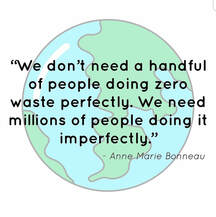 What does zero waste mean? The definition adopted by the Zero Waste International Alliance (ZWIA) is: “The conservation of all resources by means of responsible production, consumption, reuse, and recovery of all products, packaging, and materials, without burning them, and without discharges to land, water, or air that threaten the environment or human health.”
Zero waste encompasses recycling and reusing resources, but more broadly focuses on restructuring production and distribution systems to reduce the volume and toxicity of waste and to conserve resources. Why consider zero waste when we’re satisfied with our current consumption and trash disposal practices? In addition to consuming more of earth’s resources than are regenerated our trash is poisoning us and the other lifeforms that share our planet. Plastic is being found in the flesh of fish and sea creatures including fish that we eat. There is plastic in the ocean and on our beaches. A particularly evocative image was in a National Geographic article from May 2018. Imagine 15 grocery bags filled with plastic trash piled up on every single yard of shoreline in the world. That’s how much land-based plastic trash ended up in the world’s oceans in just one year. This year scientists found microplastics in the air that we breathe. The pervasiveness of plastic pollution points out how important it is to reduce the amount of plastic we use and dispose of. To learn more about interesting day-to-day ways to reduce waste and conserve resources join our November 10 book discussion of 101 Ways to Go Zero Waste by Kathryn Kellogg. It will be a brown bag event from 12 to 1 p.m. Kathryn Kellogg is a blogger who has reduced her household waste for two years to one 16-ounce mason jar. -Ella Ingraham, for the Green Team 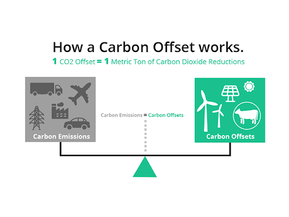 One of the tools in the Creation Care toolbox is the carbon offset. A carbon offset is a reduction in emissions of carbon dioxide or other greenhouse gases made to compensate for emissions made elsewhere. People may buy them to offset air travel or part of their total greenhouse gas emissions as a household. Some airlines offer them to offset the significant emissions associated with flying. I went to the website Terrapass and found out that for traveling from Boston to San Francisco and back, my estimated emissions would be 3,487 pounds of CO2 and an offset would cost $17.40.
You may ask, is this effective? According to a study by Stanford University of California mandated program limiting carbon emissions to 1990 levels by 2020, they are effective because they’ve required forest owners to change their practices as part of making credits available and polluting companies have had to reduce emissions because the pool of available credits is limited. There have been side benefits in preserving habitat for endangered species. In addition, when you purchase an offset, it may be tax deductible when the offset is purchased from a nonprofit. - Ella Ingraham, for the Green Team |

Green TeamWe hope to help our community become stewards of creation. Categories
All
Archives
February 2024
|


 RSS Feed